History and philosophy
Where the bulthaup kitchen comes from
Before designing a logo, a designer wanted to understand what a kitchen is. That question led, in 1982, to a book that still explains how we work today.
A question before a logo
In the late 1970s, Gerd Bulthaup asked Otl Aicher – the designer behind the visual identity of Lufthansa and the Munich Olympic Games – to create the corporate identity for his company. Aicher replied that first he needed to understand what a kitchen is. His research became a book, Die Küche zum Kochen (1982), known in English as The Kitchen is for Cooking and published in Spanish as La cocina para cocinar. In the preface, Gerd Bulthaup explains that the themes that still guide the brand were already there: purity of materials, ergonomics and functionality.
The kitchen designed for one person
To understand Aicher, you have to look back to the 1920s. In Ernst May's housing estates in Frankfurt, the Viennese architect Margarete Schütte-Lihotzky designed a kitchen calculated down to the last detail for working-class families in which the woman also worked outside the home. It was an enormous social advance and became the model for the modern kitchen: a narrow, efficient galley that was easy to clean.
But it was a space for one person, facing the wall and cut off from the life of the house. Aicher respects that project; what he questions is that for decades it was copied without anyone asking a single question.
What he learnt by asking cooks
Aicher did something simple: he visited small restaurants in France, Italy, the United States, Switzerland and Germany and asked the people who cook. He found kitchens that had grown piece by piece around each cook's way of working, and one constant: in a professional kitchen, the centre is not the stove but the place where food is prepared.
A worktable at the centre
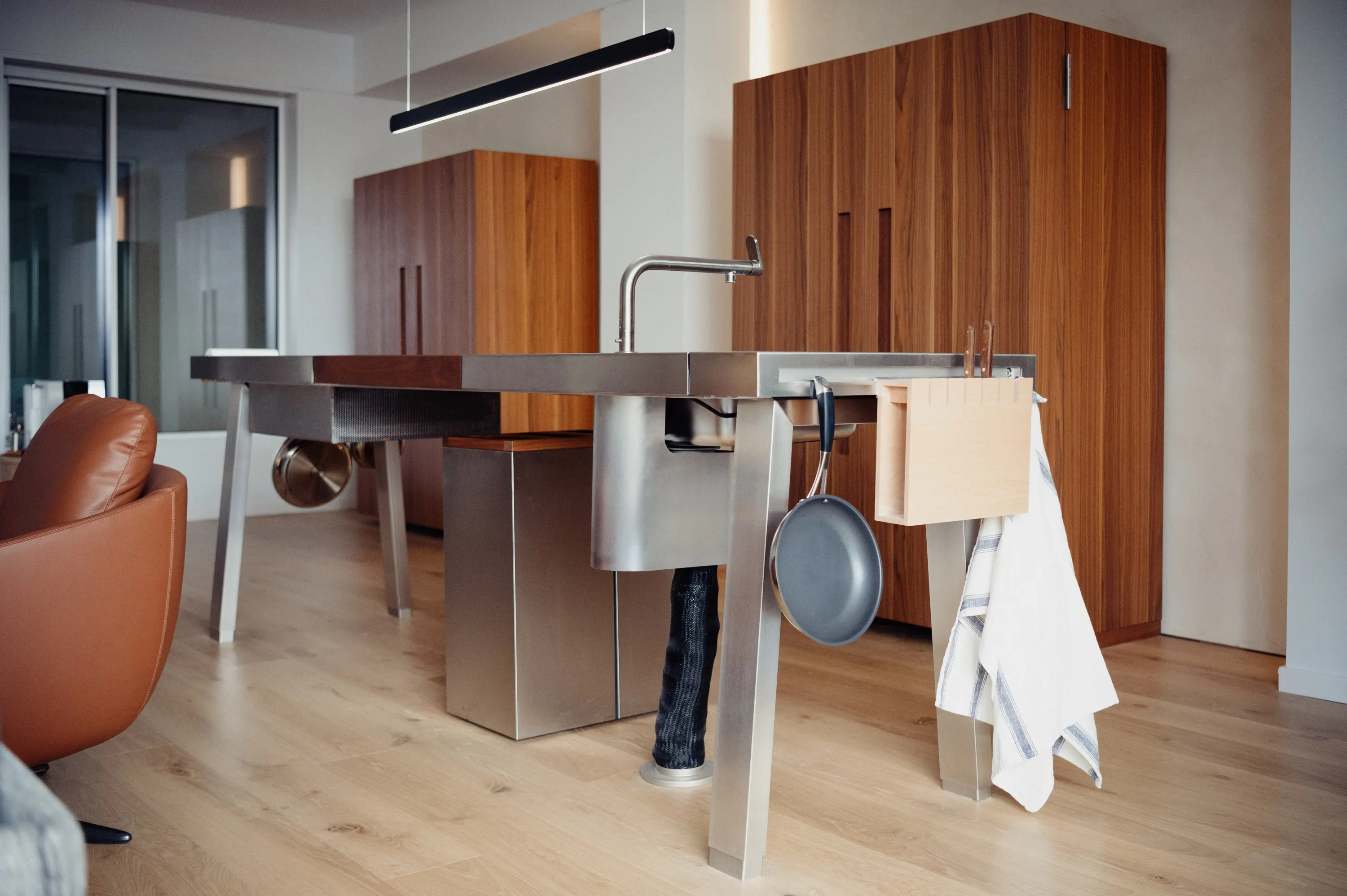
From there comes his proposal for the home: a worktable at the centre, for working standing up, with a wooden board for chopping and the knives and spices close at hand. Around it, four positions – cleaning, preparing, cooking and serving – and room for two or three people to work at the same time while carrying on a conversation.
“Cooking is an activity for several people.”
Otl Aicher, La cocina para cocinar (Spanish edition), p. 43
What you use, in view and within reach
Aicher criticised smooth fronts that hide everything and force you to open and close doors endlessly. He proposed that everyday things should be in view and within reach – hung up, propped, on shelves – and that closed cupboards should hold what is used only occasionally.
“The nobility of the kitchen no longer lies in a clear, clean appearance, but in its availability.”
Otl Aicher, La cocina para cocinar (Spanish edition), p. 93
Everywhere else he asked for calm: wood that ages well, steel, glass, a light background and layered lighting, so that nothing competes with what is being cooked.
How we apply it today
More than forty years later, Aicher's question is still the first one we ask on every project: not how a kitchen looks, but how it is used, and with whom. That is why we begin with how each family lives, open the kitchen to the rest of the house when it makes sense, put the preparation area at the centre and keep what is used every day close at hand.
You can see it in a bulthaup b2 in an apartment in Valencia, with its workbench and tool cabinet, and in our own kitchen, where a large worktable is the heart of the home.
Source: Otl Aicher, La cocina para cocinar, Editorial Gustavo Gili, Barcelona, 2004 (original edition: Die Küche zum Kochen, Callwey, Munich, 1982; in English, The Kitchen is for Cooking). Original text by bulthaup valencia & moraira; short quotations are given with their page numbers in the Spanish edition, translated by us.
Shall we talk about your kitchen?
Our first conversation is not about selling you anything. It is about understanding how you live, and telling you honestly whether bulthaup is right for you.